.png?width=156&height=44&name=Aviator%20Zone%20Academy%20(5).png)


Expanding Access to Flight Training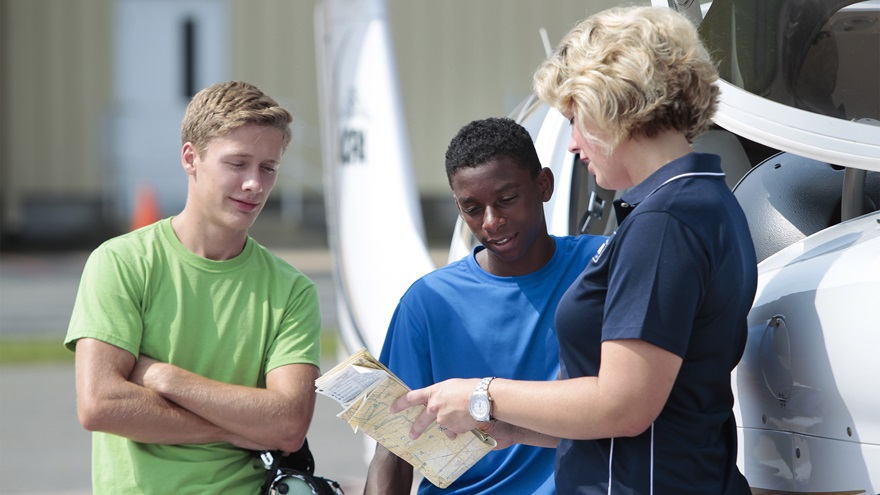
Flight training requires a consistent financial commitment that can be difficult for many students to maintain. Recognizing this challenge, the AOPA Foundation awards more than one million dollars in scholarships each year, providing direct financial assistance to support flight and maintenance training.
Scholarships are available for a wide range of applicants, including:
- Students pursuing initial flight training
- Pilots working toward advanced certificates or ratings
- Individuals seeking aviation maintenance training
- High school students preparing to earn a Private Pilot Certificate
By addressing financial barriers, the AOPA scholarship program helps students maintain continuity in training—an essential factor in skill development, safety, and long‑term success in aviation.
Structured Funding with Clear Purpose
AOPA scholarships are designed to support formal training environments. Funds are issued through a prepaid expense card and can be used only for approved training costs.
Recipients are expected to complete training within defined timelines — typically within 12 months. This structure encourages accountability, consistency, and professional development.
Events such as the Banyan Aviation Expo further support this pathway by connecting students with instructors, schools, and aviation organizations. These in-person opportunities help strengthen industry relationships and expand awareness of available resources.
Key Details
Spring Application Period: April 1 – June 30, 11:59 p.m. EST. Scholarships will be awarded in September.
Fall Application Period: October 1 – December 31, 11:59 p.m. EST. Scholarships will be awarded in March 2027.
Eligibility: Open to current AOPA members who are residents of the United States & District of Columbia, Canada, Guam, Puerto Rico, and the U.S. Virgin Islands. High School students qualify for a free membership.
Award Amounts:
- Numerous scholarship opportunities ranging from $250 to $14,000 (amounts may vary depending on donor funding)
- High School Students: At least 90 scholarships of $12,000 each for students aged 16–18 to earn their private pilot certificate.
- Teachers Using the AOPA You Can Fly Curriculum: Apply for one of up to 20 scholarships, at $12,000 each, to earn your private pilot certificate.
Full details and application access are available through AOPA’s official scholarship portal at:
https://www.aopa.org/training-and-safety/students/aopa-flight-training-scholarships
How It Works
- Sign In: When applications open, create an account in AOPA's application system (your AOPA login won’t work here).
- Complete the General Application: With just one application, you’ll automatically be matched to all scholarships you’re eligible for.
- Upload Required Documents: Transcript, references, and other materials must be submitted before the deadline.
- Submit On Time: Late or incomplete applications will not be accepted.
- Didn’t Get Selected? Don’t worry, your application will be considered for the next application period.
Questions? Send your inquiries to: FTscholarship@aopa.org
If You’re Selected
- All applicants — whether selected or not — will be notified by email. Please use an address you check regularly.
- Scholarship funds are provided via a prepaid expense card.
- Flight training must be completed within 12 months of your award date; maintenance training within 24 months.
Featured Scholarship Opportunities
AOPA offers a wide variety of named scholarships, each with unique eligibility requirements and award amounts. Here are some of the notable opportunities available:
AOPA Foundation You Can Fly High School Flight Training Scholarship
Award: At least 90 scholarships of $12,000 each
Certificate: Private Pilot Certificate
Criteria: High school student aged 16–18, minimum GPA of 2.7, must have passed the FAA Private Pilot written knowledge exam before applying.
Donor: The Ray Foundation, established by the late aviator and philanthropist James C. Ray.
AOPA Foundation You Can Fly Teacher Flight Training Scholarship
Award: Up to 20 scholarships of $12,000 each
Certificate: Private Pilot Certificate
Criteria: Current, paid, full-time teacher utilizing the AOPA Foundation High School Aviation STEM Curriculum in the 2025–2026 school year; must have passed the FAA Private Pilot written knowledge exam before applying.
Donor: The Ray Foundation.
The Alliance Texas AOPA Aviation Scholarships
Award: $14,000 for flight training; $2,700 for aviation maintenance
Certificates: Two flight training scholarships and two aviation maintenance scholarships
Criteria: Available fo r high school students enrolled in Northwest ISD or Eagle Mountain Saginaw ISD in Fort Worth, TX.
Donor: H. Ross Perot Jr. via the AllianceTexas Foundation.
AOPA Foundation Scholarship
Award: $2,500 and up (number of awards will vary)
Certificate: Primary certification (Sport, Recreational, or Private Pilot certificate)
Criteria: Must be at least 16 years old at the time of application and hold a student pilot certificate.
The Fred and Diane Fitts Memorial Flight Training Scholarship by CAA
Award: $7,500 each
Certificate: Private pilot certification or instrument rating
Criteria: Ages 17–35; preference given to applicants interested in becoming corporate pilots and members of CAA.
Donor: Corporate Aircraft Association (CAA) in memory of Fred and Diane Fitts.
The Ceci Stratford Flight Training Scholarship
Award: Two $5,000+ scholarships
Certificates: One for primary certification; one for an advanced rating
Criteria: Must be at least 16; female applicants only.
Donor: Ceci Stratford, a CFI and former Peace Corps Volunteer from Simi Valley, California.
The Carlsbad Jet Center and Sonoma Jet Center General Aviation Professional Scholarships
Award: Two awards of $6,000 each
Career Path: Flight Dispatcher, FBO Manager, Airport Manager, or Aircraft Engineer
Criteria: Currently employed full- or part-time at an aviation Fixed Base Operation; pursuing a career in general aviation.
Donor: Sonoma Aviation, owner/operator of Sonoma Jet Center (KSTS) and Carlsbad Jet Center (KCRQ).
The Corporate Aircraft Association Preferred FBO Employee Scholarship
Award: 200 awards of $2,000 each (funds can be used for any aviation education purpose)
Criteria: Recipients must be an employee of a CAA-preferred FBO at the time of award.
The Richard McSpadden Scholarship for Advanced Pilot Training
Award: Quantity and amount will vary
Certificate: Advanced training such as tailwheel, upset recovery, or other advanced ratings
Donor: Funded through contributions honoring the legacy of Richard McSpadden.
Senator James M. Inhofe FAA Knowledge Test Scholarship
Award: $250 (multiple awards available)
Certificate: FAA Private Pilot Knowledge Exam or FAA Part 107 Remote Pilot Knowledge Exam
Criteria: High school students in Oklahoma enrolled in the AOPA Foundation You Can Fly STEM curriculum.
Donor: The State Chamber of Oklahoma.
The Julie Walker Ibrahim Wings of Opportunity Scholarship for Women in Aviation
Award: $5,000
Certificate: Private Pilot Certificate or Instrument Rating
Criteria: High school or college female students with a GPA of 2.8 or greater.
Donor: Julie Walker Ibrahim.
The Edward B. Shafer Future of Flight Scholarship
Award: $5,000
Criteria: Currently enrolled at an accredited university or college pursuing a career in aviation; preference given to applicants in the Midwest, females, and minorities.
Donor: Paul Guse in memory of Edward B. Shafer.
Investing in Aviation's Future
Aviation has always advanced through education, mentorship, and community support. Programs like the AOPA Flight Training Scholarships help ensure that financial challenges do not prevent motivated students from pursuing aviation careers.
For many future pilots, simply being aware of opportunities like these can be the first step toward building a sustainable training path.

.png?width=178&height=50&name=Aviator%20Zone%20Academy%20(5).png)
Submit a Comment